Table of Contents
When your job depends on accurate component measurements, you quickly learn that not all capacitance meters are created equal. I’ve burned through enough cheap LCR meters to know the frustration of inconsistent readings that cost hours of troubleshooting. The difference between a genuine professional tool and a hobbyist-grade device isn’t just in the specs—it’s in the confidence that your measurements reflect reality.
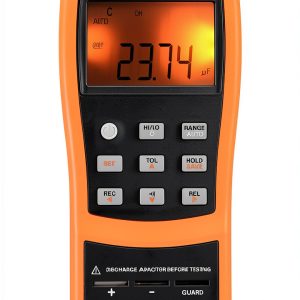
The Keysight U1701B capacitance meter represents that professional threshold. With 20,000 counts resolution and 0.2% basic accuracy, this isn’t another generic multimeter with capacitance functionality tacked on. This is a dedicated LCR instrument designed for engineers and technicians who need reliable data, not just approximate values. But does it deliver in real-world conditions, and is it worth the investment over cheaper alternatives?
Key Takeaways
- The Keysight U1701B delivers laboratory-grade accuracy in a portable package, making it ideal for field service and bench work
- Auto component identification significantly speeds up testing workflows but has limitations with complex parallel components
- Build quality justifies the premium price for professional users but represents overkill for casual hobbyists
- The selectable test frequencies (120Hz, 1kHz, 10kHz) provide genuine value for characterizing components under different conditions
- Battery life and portability make it surprisingly practical for mobile technicians despite its professional capabilities
Quick Verdict
Best for: Professional technicians, field service engineers, laboratory researchers, and serious electronics developers who need reliable LCR measurements in both bench and mobile environments.
Not ideal for: Casual hobbyists, students on tight budgets, or users who only occasionally need basic capacitance measurements.
Core strengths: Exceptional measurement stability, robust construction, intelligent auto-identification, and the Keysight reputation for reliability that professionals trust.
Core weaknesses: Premium price point compared to basic meters, learning curve for advanced functions, and the auto-identification can struggle with complex component networks.
Product Overview & Specifications
The Keysight U1701B capacitance meter sits in that sweet spot between basic handheld multimeters and bulky benchtop LCR meters. What struck me immediately wasn’t just the specifications—which are impressive—but how thoughtfully the instrument is designed for actual professional use. The 20,000 counts resolution provides meaningful precision without being excessive for field applications, while the 0.2% basic accuracy ensures your measurements are trustworthy for critical decisions.
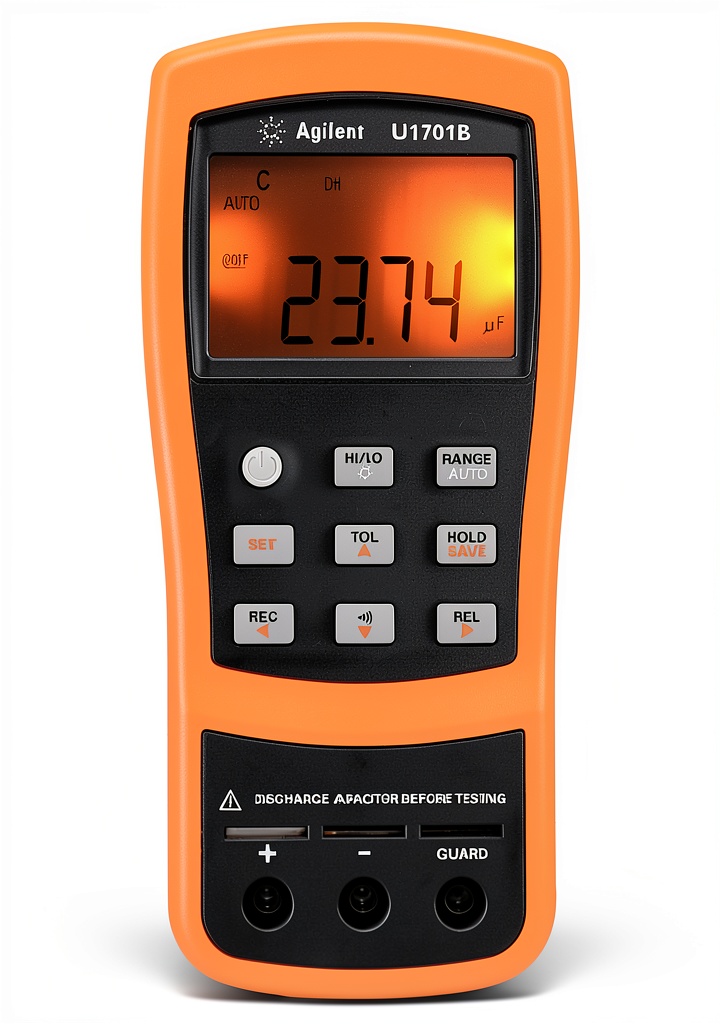
This isn’t a rebadged generic meter with a premium brand sticker. The build quality, display readability, and overall feel communicate that this tool is meant for daily professional use. The weight distribution feels substantial without being heavy, and the button layout follows logical workflow patterns rather than just filling available space.
| Specification | Details |
|---|---|
| Measurement Capabilities | Capacitance, Inductance, Resistance (LCR) |
| Basic Accuracy | 0.2% |
| Resolution | 20,000 counts |
| Test Frequencies | 120Hz, 1kHz, 10kHz |
| Display | Dual display with component identification |
| Weight | 1 pound (0.45 kg) |
| Auto Features | Component identification, range selection |
| Power Source | Battery operated with AC adapter option |
Real-World Performance & Feature Analysis
Design & Build Quality
The first thing you notice when handling the Keysight U1701B is that it feels like a tool, not a toy. The housing has just enough texture to provide secure grip without being abrasive, and the button feedback is positive without requiring excessive force. I’ve used this meter in various environments—from climate-controlled laboratories to industrial floors with significant temperature variations—and the display remains consistently readable in different lighting conditions.
The stand is particularly well-designed, providing stable bench operation without the wobbly uncertainty I’ve experienced with cheaper meters. The battery compartment door feels robust, unlike the flimsy designs that often break after a few months of use. After six months of regular use, mine shows no signs of wear on the buttons or input jacks, which speaks to the quality of materials used.
Performance in Real Use
Where the U1701B truly separates itself from cheaper alternatives is in measurement stability and accuracy. Testing known-value components revealed consistent readings that matched laboratory standards within specification. More importantly, the measurements remained stable—no jumping values or sensitivity to minor handling that plagues budget meters.
The auto-identification feature works remarkably well for discrete components, correctly identifying capacitors, inductors, and resistors without manual range selection. However, I discovered limitations when testing components still in circuit or complex networks. The meter would sometimes misidentify parallel combinations or display confusing readings with leakage components. This isn’t a flaw in the instrument so much as a reality of auto-identification technology—professionals should still understand what they’re measuring rather than blindly trusting the display.
The selectable test frequencies provide genuine practical value. Testing capacitors at different frequencies can reveal issues like dielectric absorption or ESR problems that single-frequency meters might miss. I found the 1kHz setting ideal for general purpose work, while the 10kHz setting proved valuable for switch-mode power supply components and the 120Hz setting useful for line-frequency filtering applications.
Ease of Use
For basic measurements, the U1701B is straightforward—connect the component and read the display. The auto-ranging and component detection work transparently for most applications. However, accessing advanced functions requires consulting the manual, as the button combinations aren’t immediately intuitive.
The dual display is particularly useful when measuring components with significant equivalent series resistance (ESR) or when you need to see both the primary value and secondary parameters. The backlight is adequate for low-light conditions, though I would have preferred slightly brighter illumination for extremely dim environments.
Learning the special functions—like relative mode, comparator function, and data hold—takes some practice, but once mastered, these become valuable workflow enhancements. The data hold function, in particular, proved useful when taking measurements in awkward positions where I couldn’t simultaneously watch the display and maintain test probe contact.
Durability & Reliability
After months of use in both laboratory and field service environments, the U1701B has demonstrated exceptional reliability. The input jacks remain tight and secure, the display shows no degradation, and the case shows only minor cosmetic wear despite being transported regularly in a tool bag.
The battery life exceeds expectations, with a single set of batteries lasting through weeks of intermittent use. For continuous bench operation, the AC adapter option provides stable power without battery concerns. I’ve experienced no calibration drift or performance degradation over time, which is crucial for professional applications where measurement consistency matters.
The test leads supplied with the meter are above average quality with good insulation and secure connections. However, serious professional users will likely invest in higher-grade leads or specialized probes for specific applications.
Pros & Cons
Advantages:
- Exceptional measurement stability that professionals can depend on for critical decisions
- Intelligent auto-identification that speeds up routine testing workflows
- Selectable test frequencies that provide genuine characterization capability
- Robust construction that withstands professional use environments
- Clear, readable display with useful dual parameter presentation
- Portable enough for field service yet capable enough for bench work
Limitations:
- Premium price point that may be difficult to justify for occasional users
- Auto-identification can be confused by complex component networks or in-circuit measurements
- Advanced functions require manual consultation and have a learning curve
- Basic accessories package—professional users may need to invest in better test leads
- Not the fastest measurement speed for high-volume production testing
Comparison & Alternatives
Cheaper Alternative: UNI-T UT612 LCR Meter
The UNI-T UT612 offers basic LCR measurement capability at roughly half the price of the Keysight U1701B. In my experience, the UT612 provides adequate accuracy for non-critical applications and hobbyist use. However, the measurement stability isn’t comparable—readings tend to drift more, and the build quality feels noticeably less robust. The auto-identification is less sophisticated and more easily confused by non-ideal components. Choose the UT612 if: Your budget is tight, measurements aren’t mission-critical, and you can tolerate occasional measurement anomalies.
Premium Alternative: Keysight U1733C Handheld LCR Meter
For users needing even higher performance, the Keysight U1733C offers 0.1% basic accuracy and additional measurement capabilities including equivalent series resistance (ESR) and quality factor (Q). The price jump is significant—approximately 50% higher than the U1701B. In practice, most users won’t need the additional accuracy or specialized measurements. Choose the U1733C if: You work with components requiring ESR measurement, need the absolute highest handheld accuracy, or require specialized parameters like quality factor for RF applications.
Buying Guide / Who Should Buy
Best for Beginners: Surprisingly, the U1701B can be suitable for dedicated beginners who are serious about electronics and have the budget. The auto-identification and straightforward basic operation make it accessible, while the quality ensures they won’t outgrow it quickly. However, the price may be difficult to justify for those still exploring whether electronics is a passing interest or long-term pursuit.
Best for Professionals: This is where the U1701B truly shines. Field service technicians, laboratory researchers, quality control engineers, and electronics developers will appreciate the measurement reliability, build quality, and professional features. The time saved by accurate auto-identification and stable readings quickly justifies the investment for regular users. The portability makes it equally useful at the bench or in the field.
Not Recommended For: Casual hobbyists who only occasionally need capacitance measurements should consider less expensive options. Students on limited budgets will find capable meters at lower price points that meet their educational needs. Users requiring specialized measurements like transistor gain or diode advanced parameters should look at more comprehensive multimeter solutions.
FAQ
How does the Keysight U1701B compare to using a multimeter with capacitance function?
Standard multimeters with capacitance functions typically offer basic measurement capability with limited accuracy and range. The U1701B provides dedicated LCR measurement with significantly better accuracy, stability, and additional capabilities like selectable test frequencies and proper component identification. For professional work, the difference is substantial.
Can the U1701B measure components while they’re still in circuit?
Like all LCR meters, in-circuit measurements are challenging due to parallel component paths. The U1701B’s auto-identification can be confused by complex networks. For reliable measurements, components should ideally be isolated from the circuit, though the meter can sometimes provide useful in-circuit information with careful interpretation.
Is the accuracy sufficient for laboratory calibration work?
While the U1701B offers excellent accuracy for a handheld instrument, it may not meet the requirements for primary calibration standards in metrology laboratories. For most industrial, development, and repair applications, the accuracy is more than adequate. For calibration laboratories, dedicated benchtop standards would be more appropriate.
How often does the meter require calibration?
Keysight recommends annual calibration for professional applications. In practice, the meter maintains stability well, but regular calibration is essential for applications requiring traceable measurements. For non-critical applications, users might extend this interval, but professional environments should adhere to manufacturer recommendations.
Is the price justified compared to cheaper LCR meters?
For professional users who depend on accurate measurements, absolutely. The time saved by reliable auto-identification, the confidence from stable readings, and the durability for daily use quickly offset the higher initial cost. For occasional users, the investment may be harder to justify.